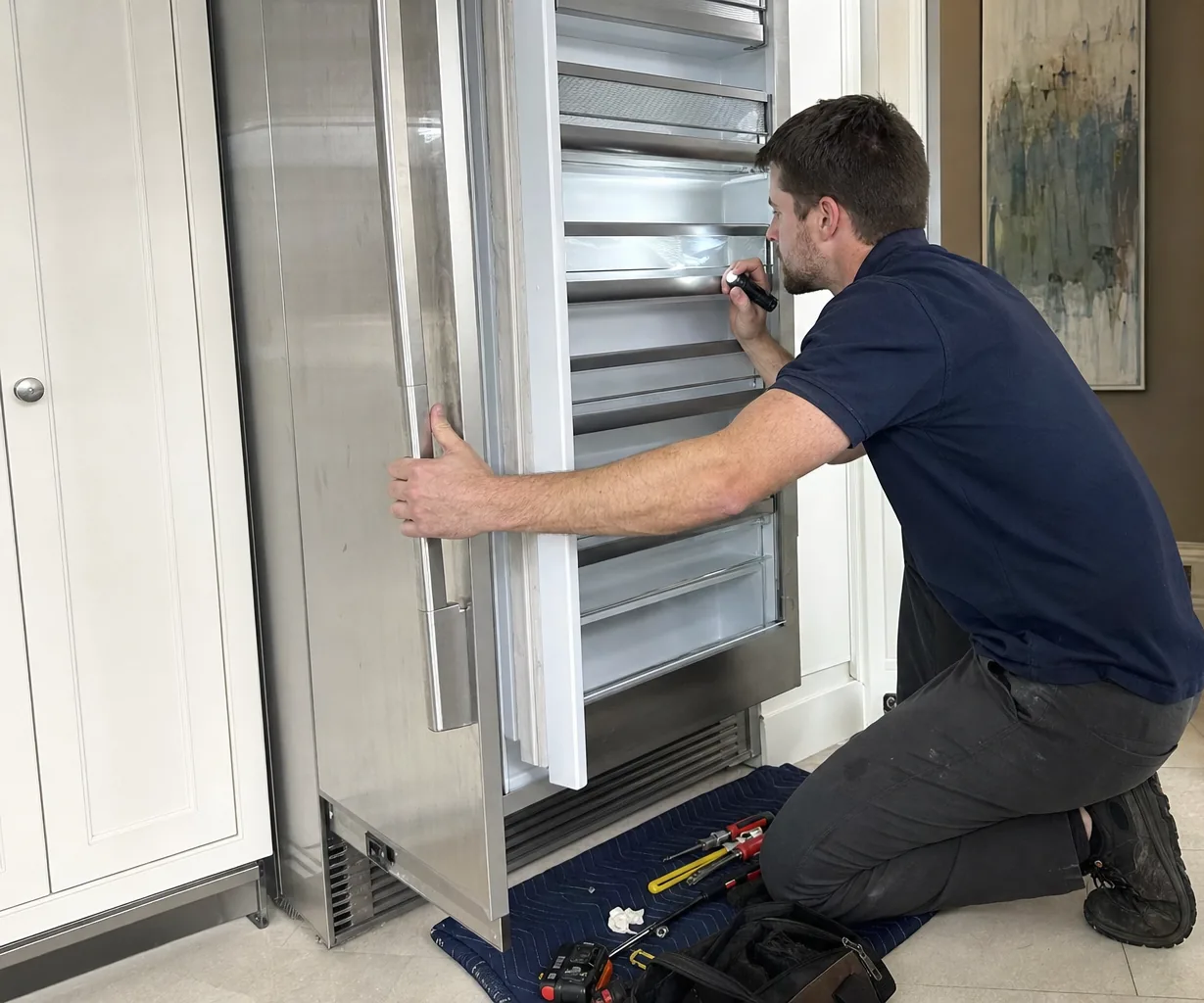
Classic series service
Classic is the current name for the full-depth built-in platform. The CL prefix replaced BI, but the architecture is continuous: a top-mounted condenser and two independent sealed systems.
- CL
- CL3650U
- CL4250SD
- CL4850SD
Built-In became Classic and BI became CL. Integrated became Designer and IT, IC, ID and IW became DET, DEC and DEU. Both vocabularies appear here, because nearly all of the installed base still carries the old names.
The model and serial plate is inside the fresh-food compartment on most full-size cabinets, usually on the upper left wall behind the top shelf, and behind the base grille on undercounter units. The prefix on that plate decides three things immediately: where the condenser is, which water filter fits, and which service codes the control can display.
Condenser location is the one people get wrong. Classic, legacy Built-In and the 430 wine unit are top-mounted behind a flip-up grille. Designer, legacy Integrated, the 700 Series and the 427 are bottom-mounted. Cleaning the wrong end of a cabinet is a wasted afternoon.
Every full-size series below runs two independent sealed systems. Wine storage and undercounter cabinets do not use that arrangement, and their pages say so rather than asserting a compressor count that varies by model.
| Built-In (BI) | now Classic (CL) |
|---|---|
| Integrated (IT/IC/ID/IW) | now Designer (DET/DEC/DEU) |
| 648PRO | legacy PRO cabinet |
| 600 / 700 Series | legacy, 1996–2009 |
Classic is the current name for the full-depth built-in platform. The CL prefix replaced BI, but the architecture is continuous: a top-mounted condenser and two independent sealed systems.
Designer is the current name for the fully integrated platform that carried the Integrated name and the IT, IC, ID and IW prefixes, and its condenser is at the bottom rather than the top.
PRO cabinets carry a commercial-style exterior over the same dual-refrigeration architecture, and the glass-door models add a heat load that changes what a marginal condenser will tolerate.
The 400 Series covers the 424 and 424FSG, the 427G and 427RG, and the 430, and the single most useful service fact about them is that the condenser is not in the same place on all of them.
Undercounter cabinets breathe through one low grille and live in the hottest position in the kitchen, so airflow, drain geometry and duty cycle account for nearly all of their service calls.
The BI cabinets built between 2008 and 2022 are the largest installed base in this service area, and most of them are now inside the years six to twelve sealed-system window.
The Integrated cabinets with IT, IC, ID and IW plates became the Designer series, and almost all of the service revenue on the integrated platform is still in these older units.
The 600 and 700 Series cabinets were built between 1996 and 2009, which puts every one of them outside all manufacturer coverage and makes the repair-or-replace conversation part of the visit.
A cabinet from the legacy years is frequently still inside the manufacturer's twelve-year limited sealed-system coverage. In years 6 through 12 the sealed-system part is still covered, parts only. A homeowner may have that work done by an independent shop: the covered part is obtained from the manufacturer directly and the homeowner pays the labor. How that works.
A model number and a serial number change the diagnosis, the parts list and sometimes the price. Sub-Zero boards in particular are serial-dependent, which is why we never quote a board number from a website.
Mon–Fri 8am–6pm · Sat 9am–4pm · Sun closed. Scheduled appointments only. No after-hours or emergency service.
40 miles by road from Fruit Cove and St. Johns County. Drive distance, not straight-line radius.
90 days labor, 365 days parts, genuine OEM components.
EPA Section 608 certified technicians — the federal requirement to open a sealed refrigeration system.