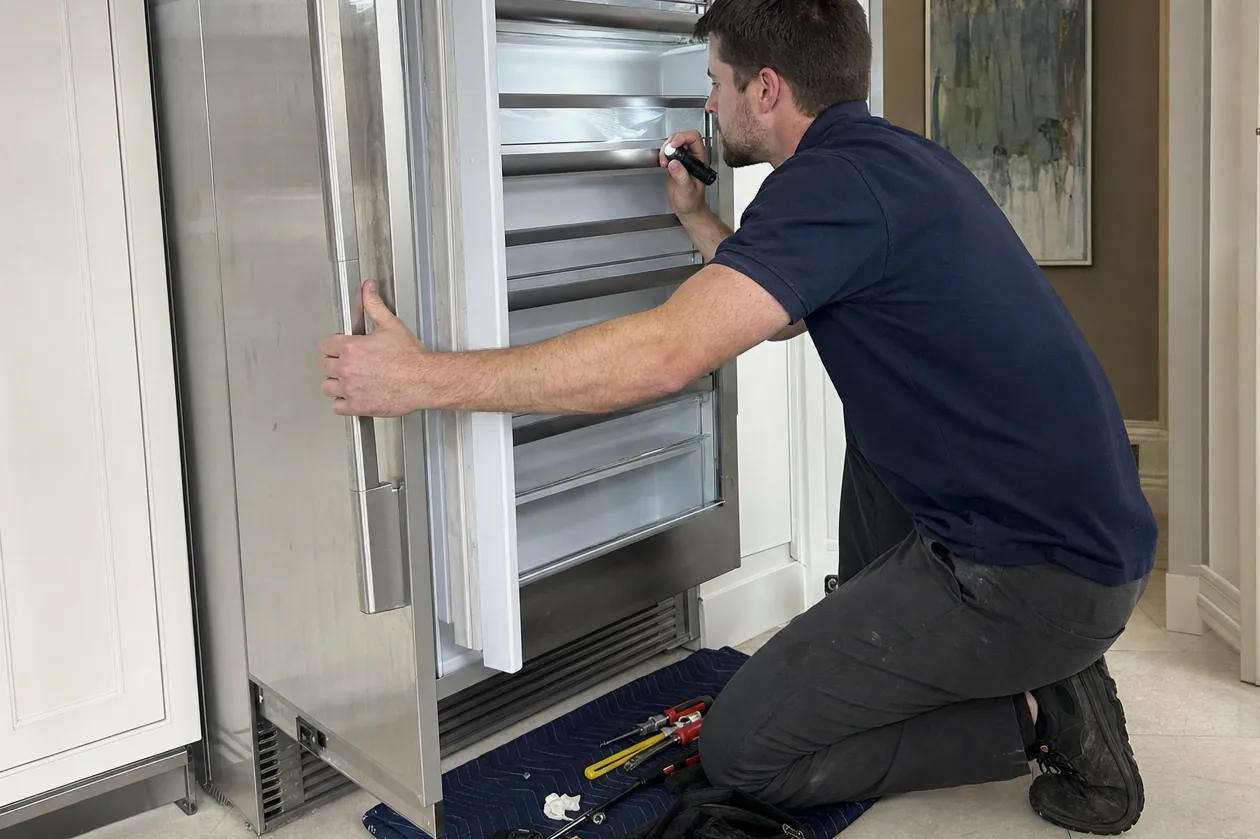
Designer is the current name for the fully integrated platform. Before the rename it was called Integrated and the plates read IT, IC, ID or IW. Designer plates read DEC, DET or DEU. Both vocabularies appear across this site because the installed base in Northeast Florida is still overwhelmingly the older one.
Integrated means flush and invisible
A Designer cabinet is designed to disappear. It takes full-overlay custom panels, sits flush with the cabinet run, and carries no visible grille at the top. That last point is the practical difference from a Classic and it drives most of what goes wrong.
The condenser is at the bottom
On Designer and legacy Integrated cabinets the condenser is at the bottom, behind the base grille. On the Classic and legacy Built-In platform it is at the top. Getting that wrong wastes a service call and, worse, leads homeowners to conclude their cabinet has no condenser to clean.
The bottom position collects different debris. Not cooking grease, which rises, but floor dust, pet hair and whatever a vacuum cleaner pushes under the cabinetry. Six to twelve month intervals, halved with pets, unnecessary under six months of age.
The bottom position is also easy to block. We see cabinets that stopped holding temperature within weeks of a kitchen refresh because a decorative toe-kick, a new floor with a thicker underlay, or a run of trim narrowed the base opening. If your Designer began struggling after cabinetry work, say so when you book; it changes the first thing we look at.
The 48°F rule applies here as everywhere: above that against a 38°F setpoint, a cleaning is unlikely to recover the compartment. And if temperatures are not back at setpoint 24 hours after a cleaning, the cabinet needs service.
Columns are separate appliances
Most Designer installations are columns: a refrigerator column beside a freezer column, sometimes with a wine cabinet in the same run. Each column has its own model plate, its own serial, its own sealed system and its own warranty clock. It is completely normal for one to need a compressor while the one beside it runs untouched for another decade.
The over-and-under Designer cabinets carry the same dual-refrigeration architecture as the built-in platform: two compressors and two evaporators, the fresh-food side cool and moist, the freezer frigid and dry. A warm refrigerator over a 0°F freezer is a single-circuit fault, not a contradiction.
Soft-close hinges and the panel
Designer doors use soft-close hinges that pull the door shut through the last part of its travel. From roughly zero to sixty degrees open, the door should close itself. New hinges are stiff and they loosen with use: the action noticeably improves over about three months.
That means two things. A brand-new installation that feels heavy is usually not faulty. And a five-year-old door that has stopped self-closing usually needs adjustment rather than a hinge, especially if the panel has been replaced with heavier stock or the handle has moved.
There is no lock on any of these doors. The seal pulls hard for a few seconds after closing because the trapped air has cooled and contracted, and it releases as the pressure equalises. Do not force a door in that window.
Water, ice and drains
Twist-in filter 4204490 or 9030868. It is a maintenance item, and the reason to change it on schedule is flow rather than taste: a saturated cartridge restricts the supply and produces thin or hollow cubes that read as a failing ice maker. Fill volume is measured before anything on the ice system is condemned, because a mold that will not release is a harvest fault — ejector, mold thermostat or mold heater — and a slab of ice at the back of the compartment is a fill tube fault. Three complaints, three different repairs.
Freezer columns on this platform freeze their drains. The blockage is ice far more often than debris. Nothing rigid goes into that tube and no boiling water goes down it, because the drain heater and evaporator pan are on the other side of it. The fix is a controlled defrost and then a diagnosis of why it froze.
Codes
If the display is showing a service code, leave it in place until the technician has seen it. Board fit is serial-dependent on this platform, so we read the plate rather than publishing board numbers.