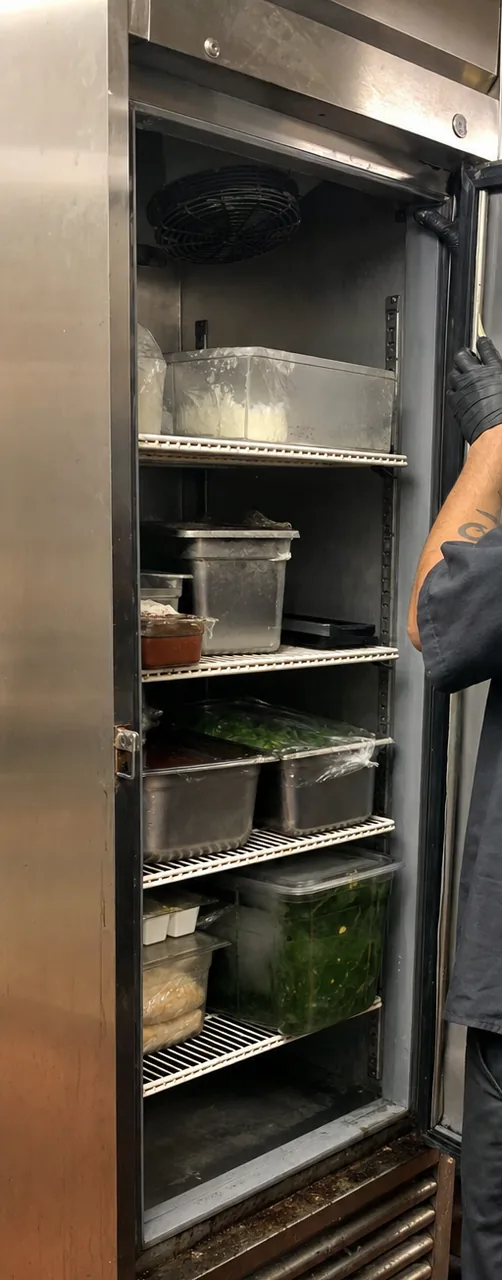
A freezer column is one cabinet doing one job. There is no fresh-food compartment above it and no second sealed system in the same box, so the diagnostic logic that applies to an over-under unit does not transfer cleanly. When a column drifts warm, the fault is on the only circuit it has.
Columns are usually installed as pairs, a refrigerator column beside a freezer column, sometimes with a third cabinet for wine. The two food columns are separate appliances with separate model plates and separate warranties. It is common for one to fail while the other runs perfectly for another five years, and it is worth reading both model plates before calling, because the repair is scoped to one of them.
Frost is a symptom, not a fault
A freezer is supposed to be dry. Frost that accumulates on packaged food, on the evaporator cover or across the ceiling of the compartment means moisture is entering faster than the defrost cycle can clear it, or the defrost cycle is not clearing it at all.
Three causes account for most of it. The first is a door that is not sealing: a gasket that has taken a set, a hinge that has dropped, or a panel that has been re-hung slightly out of plane after a cabinetry change. The second is a defrost failure, either an open heater or a termination device that ends the cycle early. The third is the drain. Once the drain freezes, meltwater backs up under the evaporator, refreezes, and the coil loses surface area every cycle until airflow stops.
The drain is frozen, not clogged
This is the single most misdiagnosed item on a column. The drain tube runs from the evaporator pan through the cabinet floor, and in almost every case the blockage is ice rather than debris. Sub-Zero’s own guidance is explicit on the point.
Do not push a wire down it and do not pour boiling water into it. There is a drain heater and an evaporator pan on the other side of that tube, and a puncture converts a two-hour repair into a sealed-system job. The correct approach is a controlled defrost with the door held open and the compartment allowed to come up to room temperature, then an inspection of the drain heater circuit to find out why it froze in the first place. A drain that freezes once will freeze again unless the cause is corrected.
Ice production has its own floor
If the column feeds an ice maker, the compartment temperature matters more than the ice maker does. Production requires the freezer at or below 5°F, and 0°F is the number to aim for. A column sitting at 8°F will keep the food frozen and will quietly stop making ice, and the resulting service call is usually booked as an ice maker fault. Read the compartment first.
Codes on legacy cabinets
On the 600 Series, the 648PRO, the 700 Series and the IC-27, an EC40 code reports excessive freezer compressor run time. The published split is useful. If the compartment is less than ten degrees above setpoint, a restricted condenser is the likely cause and cleaning it is the first step. If it is more than ten degrees above setpoint and no door has been left standing open, the unit needs a technician rather than a vacuum cleaner.
Leave the code on the display. A stored code with a timestamp tells us when the run-time excursion started, and that frequently distinguishes a slow refrigerant loss from an abrupt component failure.
Cost and coverage
The diagnostic is $80, flat, credited toward the repair, with a written estimate before anything is ordered. Parts are genuine OEM. We warrant 90 days on labor and 365 days on parts.
Column cabinets in this market are often between eight and fifteen years old, which puts many of them inside the manufacturer’s twelve-year limited sealed-system window. In years six through twelve the covered sealed-system part is still supplied, parts only, obtained from the manufacturer directly, with the homeowner paying labor. We will tell you when that applies rather than quote around it.