Undercounter refrigeration is asked to do the same job as a full-size cabinet in about a fifth of the volume, in the worst position in the room. It sits below the counter with a single low grille for air, frequently in an island with cabinetry on three sides, and in this part of Florida it is often outdoors under a covered lanai. The failure list follows directly from that.
Air comes in and goes out through one grille
Every undercounter unit is bottom-breathing. The condenser sits behind a front grille at the base and the same opening handles intake and discharge. Anything that narrows it, a decorative toe-kick, a retrofitted panel, a rug pushed against the base, raises head pressure and extends run time until the cabinet stops holding setpoint.
Cleaning that condenser every six to twelve months is not optional maintenance on these units the way it nearly is on a top-mounted Classic. Halve the interval if there are dogs or cats in the house. A unit under six months old does not need it yet.
Ambient temperature is a real limit
An undercounter cabinet in an air-conditioned kitchen has an easy life. The same cabinet in an outdoor kitchen in Ponte Vedra Beach or Nocatee in August is working against ambient air in the nineties for months at a time. Indoor-rated units installed outdoors will run continuously, drift warm through the afternoon, and recover overnight, and no component replacement changes that pattern. We measure the air at the grille before we quote anything, because that measurement decides whether this is a repair or a placement problem.
Water on the floor
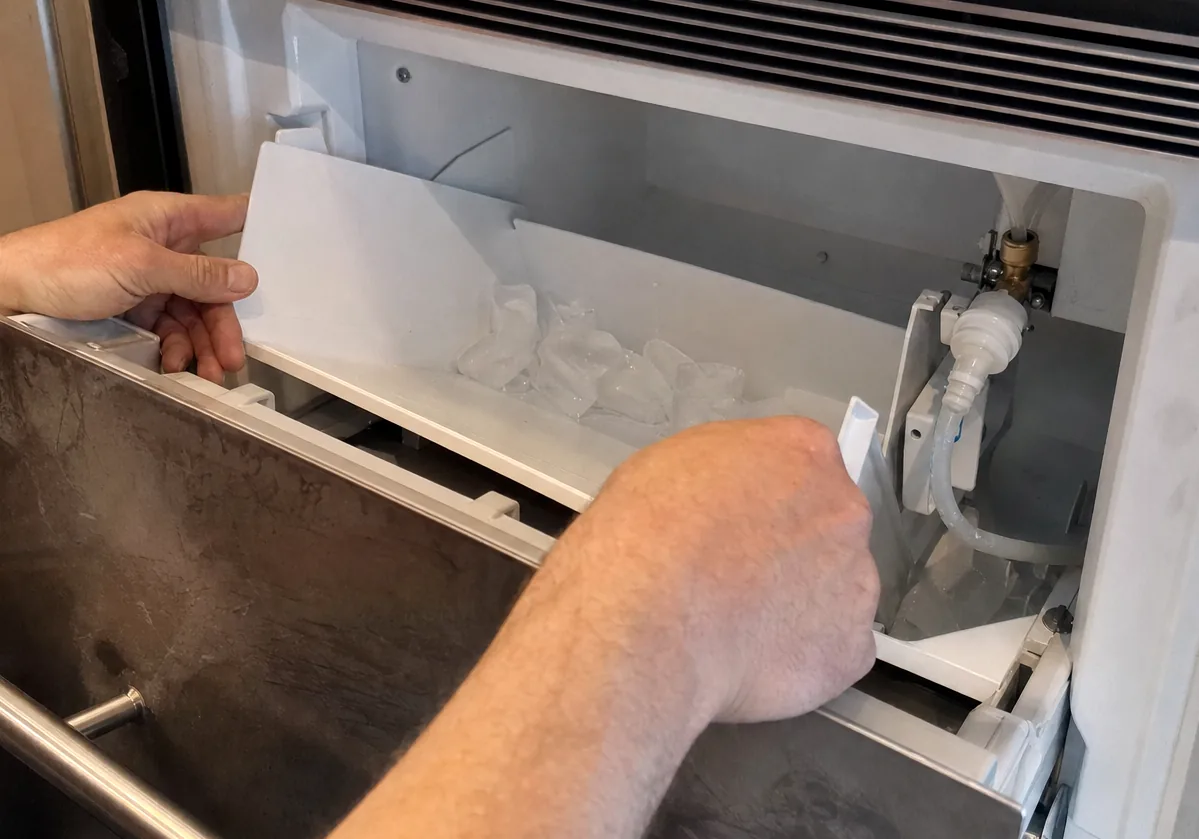
The UC-15I ice maker is a gravity-drain machine. It has no compressor-driven pump on the standard installation, so the drain line must fall continuously from the unit to the connection. A line that has been re-routed during a cabinetry job, or that sags between joists, will hold water, then overflow at the cabinet. This is the most common water complaint we see on undercounter ice makers and it is almost never a failed component.
On refrigerator and beverage models, water in the base is usually a frozen or blocked evaporator drain. As with a freezer column, the blockage is ice more often than debris. Nothing rigid goes into that tube and no boiling water goes down it.
Ice faults on a machine that is otherwise cold
The UC-15I takes filter 7042803, which replaced 7012333. Different cabinets in the range take different cartridges, so the plate is read before one is ordered, and the reason to change it on schedule is flow rather than taste: a saturated cartridge restricts the supply.
An undercounter ice maker runs a small mold hard, so it reports a supply or harvest problem earlier than any other appliance in the house. Wet, clumped or slow ice on a cabinet that is holding temperature is an ice-system fault rather than a refrigeration one, and it divides three ways. A short fill upstream of the mold gives thin, wet or undersized ice. A harvest fault at the ejector or the mold thermostat gives a full mold that will not release. A diverted fill tube gives water frozen where it should not be. We measure the fill and read the harvest cycle rather than replacing the module and hoping.
Salt air on the coast
Outdoor and near-coastal installations in 32082, 32250, 32266, 32233 and the St. Augustine waterfront take a second kind of damage. Salt aerosol enters through the grille and attacks the aluminium condenser fins, the fasteners and the hinge hardware. On a ten-year-old outdoor unit, corroded fin stock and a seized hinge are frequently the whole repair, and both are visible in the first ten minutes of the visit.
Doors, drawers and the vacuum seal
Undercounter drawers and doors are heavy for their size and they are hung on panels that a cabinetmaker fitted. Alignment drifts. A door that will not seat, or a drawer that stands proud on one corner, is an adjustment rather than a part in most cases.
There is no lock on these units. The seal pulls hard for a few seconds after closing because the air inside has cooled and contracted, and it releases as pressure equalises. Forcing it in that window is how gaskets get torn.
Cost and coverage
$80 flat diagnostic, credited toward the repair. Written estimate before anything is ordered. Genuine OEM parts, 90 days labor, 365 days parts. If a service code is displayed, leave it showing.