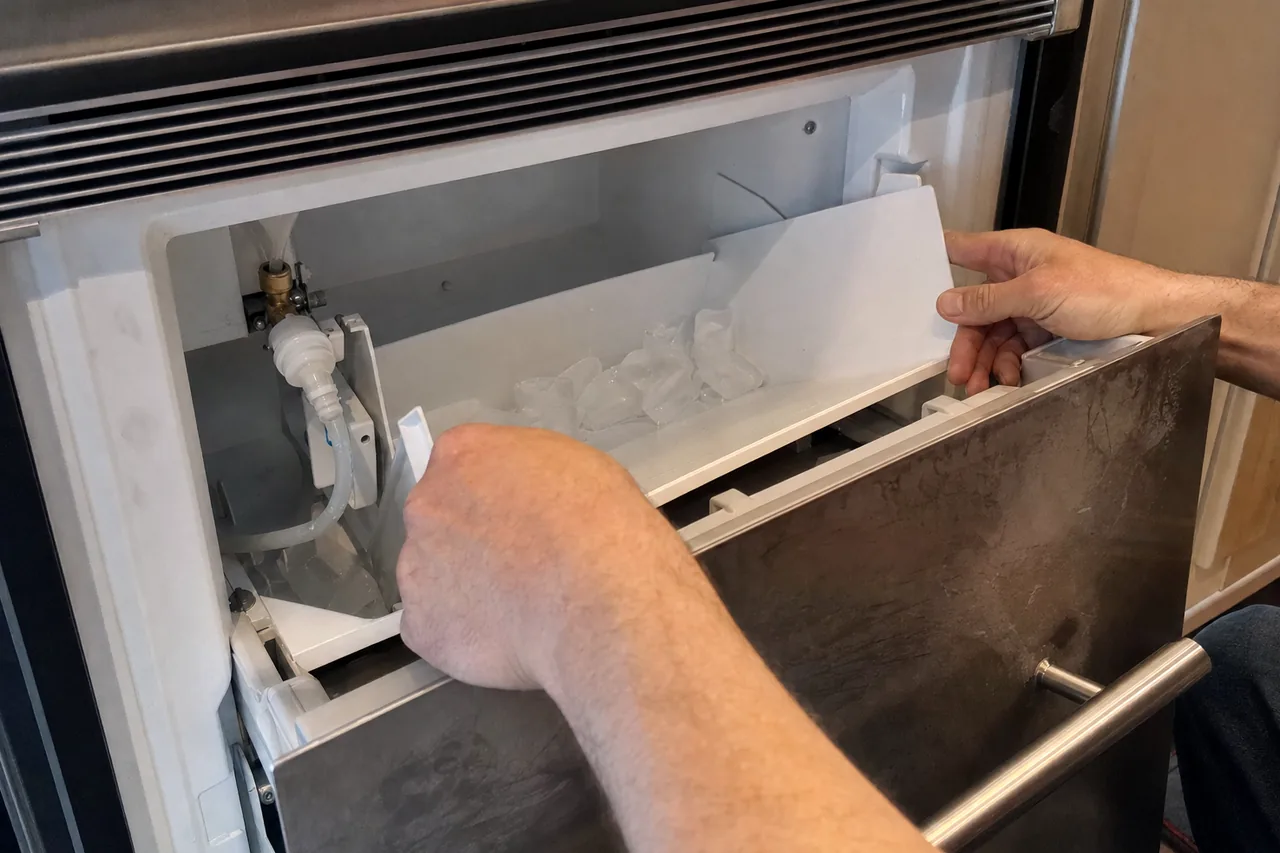
Almost every ice call arrives described the same way: the ice maker has stopped. It is one of the few appliances in the kitchen that people are willing to declare dead over the phone, and it is one of the least likely to actually be dead.
There are four things that produce no ice, and they present differently enough to separate before a panel comes off. We work them in the same order every time, because each check invalidates the one after it.
First: the compartment temperature
Ice production requires the freezer at or below 5°F, and 0°F is the recommended setpoint. That floor is not a preference, it is what the harvest cycle needs to complete.
A compartment holding 8°F will keep food frozen indefinitely and simply stop harvesting. Nothing in the ice system is wrong. The refrigeration is, and it is a different repair with a different price. Reading the compartment first is what stops us selling an ice maker to fix a defrost fault.
On a full-size cabinet this is also the point where two sealed systems matter. The freezer circuit is independent of the fresh-food circuit, so a freezer drifting warm while the refrigerator holds 38°F perfectly is not a contradiction. It narrows the diagnosis to one side of the cabinet.
Second: is water arriving, and how much
Thin cubes, hollow cubes and undersized cubes are not a failure to make ice. They are a failure to receive the right volume of water, and the cause sits upstream of the mold.
We measure the fill rather than judge it by eye, because a fill that is thirty per cent low still looks like water going in. The candidates, in the order they are worth checking: a saturated filter restricting flow, a supply valve that was never fully opened after a previous job, a kinked or crimped supply line behind the cabinet, and the inlet valve itself failing to open fully.
Only one of those is a part. The rest are found by looking.
Third: the harvest
If the fill is correct and the cubes are full size but will not come out, the fault is in the harvest cycle rather than the supply.
A stalled ejector, a mold thermostat that never satisfies, and a mold heater that has failed open all present as a full mold that stays full. They are distinguished electrically, not visually, and this is the point where the panel comes off.
The signature of a fill tube problem is different again and it is worth naming, because it is the one homeowners describe most vividly: water arrives, misses the mold, freezes at the back of the compartment, and builds a slab that people report as the ice maker overflowing. The tube has been diverted or the tube heater has failed. Nothing is wrong with the mold.
Fourth: the machine’s own environment
Undercounter ice makers and undercounter refrigerators breathe through a single low grille that does both intake and discharge. Block it with a cabinetry change, a toe-kick panel or stored boxes and production falls off long before the cabinet warms enough for anyone to notice.
Outdoor installations under a lanai are the extreme case. An indoor-rated cabinet working against ambient air in the nineties runs continuously, drifts warm through the afternoon and recovers overnight, and no part replacement changes that. We measure air temperature at the grille before quoting anything, because sometimes the honest answer is placement.
The parts that are actually involved
Fill valves, fill tubes and tube heaters, mold thermostats and ejector assemblies account for most of the parts on this repair. Filters are not parts in this sense — they are a maintenance item, and the reason to change one on schedule is flow, not ice quality.
Serial numbers matter here more than people expect. Ice maker assemblies changed across the production runs of the same nominal series, and the plate decides which one fits. We read it on site rather than ordering from a model number quoted over the phone, and where a part is on backorder we say so before the visit rather than after the cabinet is open.
When to stop repairing one
An ice maker in a cabinet that is otherwise sound is nearly always worth repairing. The exception is a machine that has already had its mold assembly replaced and is failing again for the same reason, because at that point the cause is upstream of the appliance and replacing the module a second time resets nothing.
If the cabinet is inside the manufacturer’s two-year full parts and labor coverage, call the manufacturer instead of us. We will say so on the phone rather than take a diagnostic fee for something you are already covered for.