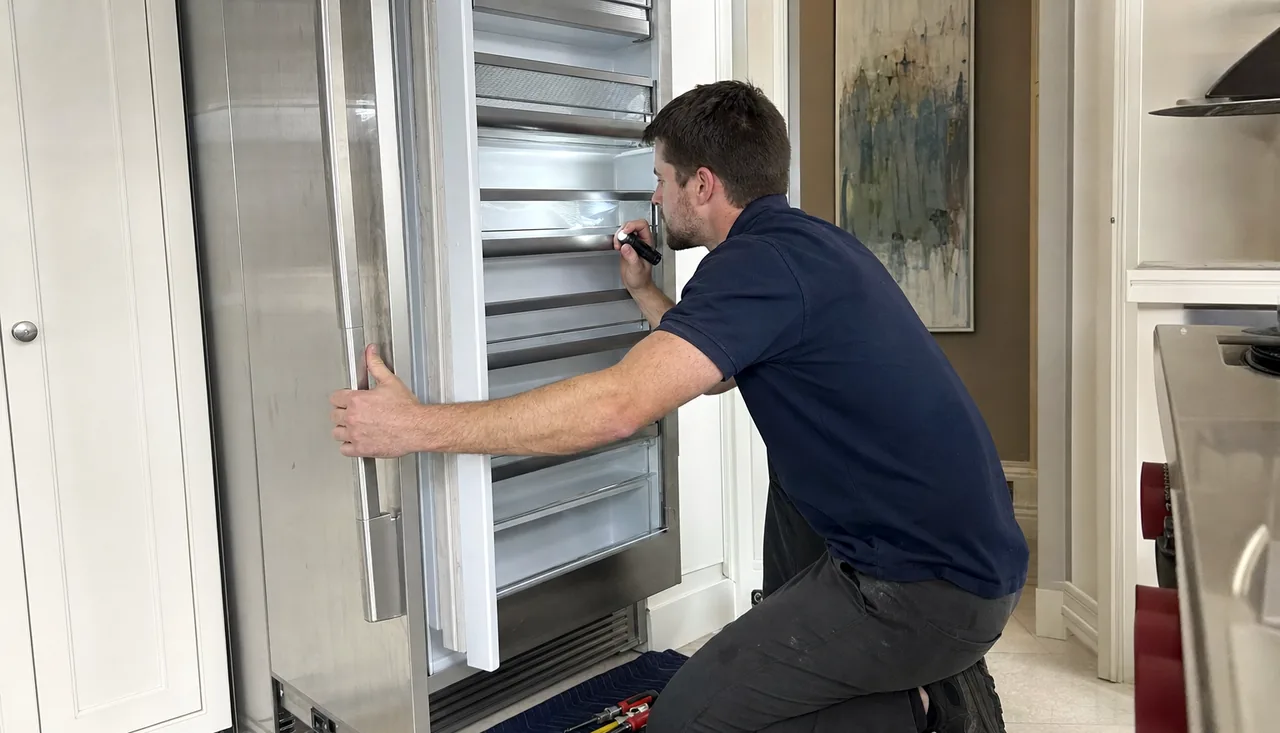
The single most useful thing to know about a full-size built-in refrigerator is that it is two refrigerators in one cabinet.
Two compressors. Two evaporators. Two independent sealed systems, one for each compartment. They share a condenser assembly and a control, and that is nearly all they share.
Why it was designed that way
A domestic refrigerator with one sealed system cools the freezer and then blows some of that cold, very dry air into the fresh-food compartment through a damper. It works, and it has a cost: the fresh-food side ends up dry. Produce wilts. Cheese hardens at the edges. Odours travel between compartments because the same air is circulating through both.
A dual-refrigeration cabinet does not do that. The fresh-food system is run to hold 38°F at a deliberately high humidity, so food does not dry out. The freezer system is run to hold 0°F and to stay dry, because moisture in a freezer becomes frost. The two air masses never mix.
That is the design argument, and it is the reason these cabinets cost what they do. It is also why the diagnosis is different.
What it means when something goes wrong
Because the systems are independent, they fail independently. The normal way that presents is a warm refrigerator over a freezer that is exactly at setpoint.
Customers report this as impossible. Service companies that have never opened one of these cabinets write about “the compressor” and diagnose accordingly. Both are wrong in the same way: there is no the compressor. There are two, and one of them is fine.
Once the compartments are read separately, the fault list on the affected circuit is short. A failed evaporator fan on that circuit stops air moving over a coil that is still cold, so the compartment warms while the coil ices over. A defrost failure lets frost bridge the evaporator until airflow stops. A thermistor reading low tells the control the compartment is already at setpoint. A restriction or a slow refrigerant loss on that one circuit gives a coil that frosts only partway across its face and a compartment that holds in winter and fails in August.
Each of those has a distinct signature at the coil. That is why the evaporator cover comes off before anything is quoted.
The two numbers that decide the next step
Sub-Zero publishes a threshold that is worth memorising. If the fresh-food compartment is above 48°F against a 38°F setpoint, it is unlikely to recover from a condenser cleaning. Above that line something has failed rather than fouled, and cleaning is not the answer.
Below that line, clean the condenser first — it is the one cause a homeowner can address without tools, and a restricted condenser degrades both circuits at once because they share it.
The second half of the rule is the part people skip. If temperatures have not returned to setpoint within 24 hours of a cleaning, the cabinet needs service. Not a week. Twenty-four hours.
What does not have two systems
Not everything in the range is dual refrigeration. Single-purpose columns have one sealed system each, because they only have one compartment — which is why a refrigerator column and the freezer column beside it are two separate appliances with two separate warranty clocks.
Undercounter cabinets have one sealed system. Wine storage does not use the dual-refrigeration arrangement at all; on a dual-zone wine cabinet the two zones are set independently, but the diagnostic question is capacity and control rather than which of two systems failed.
Before you call
Put an independent thermometer in each compartment and leave it two hours. Note both readings and both setpoints. If the display is showing a code, write it down and leave it showing.
Those three pieces of information tell us which circuit to investigate before we arrive, and on a cabinet with two of everything that is worth a great deal.