Orange Park is on the other side of the river from our base, and the housing here spans enough decades that the refrigeration does too. A single street can hold a thirty-year-old cabinet in an original kitchen and a two-year-old column in a renovation.
That makes two things carry most of the diagnosis on this side of the river: what the display is showing, and what the serial plate says.
The codes on the older cabinets
EC40 is the code to know on this generation. It reports excessive freezer compressor run time, and it has a published decision rule attached to it. Under ten degrees above setpoint, clean the condenser and re-check. Over ten degrees above setpoint with no door left standing open, book service. It applies to the 600, the 648PRO, the 700 Series and the IC-27.
EC50 is the SERVICE indication. After a condenser cleaning, it is cleared by holding the door-ajar alarm key for fifteen seconds — but only once temperatures are near normal. Clearing it while the cabinet is still warm tells you nothing except that the light went out.
If a 600 Series cabinet shows EE, the manufacturer’s published position is that there is no consumer troubleshooting for it. That is not us being cautious. It is what the manufacturer states.
Leave any code showing until the technician has seen it. A stored code records when the excursion began and how the control responded, and on a cabinet with two sealed systems that is frequently what identifies the failed circuit. Cleared codes cost us diagnostic information and sometimes cost you a second visit.
Condenser first, and where it is
Condenser restriction remains the most common cause of a cabinet that has slowly stopped keeping up. Clean it every six to twelve months, every six with pets, not at all under six months of age.
Location depends on the series. Classic CL and legacy Built-In BI cabinets, and the 430 wine unit, are top-mounted behind a flip-up grille. Designer and legacy Integrated cabinets, the 700 Series and the 427 are bottom-mounted behind the base grille.
Two rules ride along. Above 48°F in the fresh-food compartment against a 38°F setpoint, a cleaning is unlikely to recover it. And if temperatures have not returned to setpoint within 24 hours of a cleaning, the cabinet needs service.
Ice, in the order it is actually checked
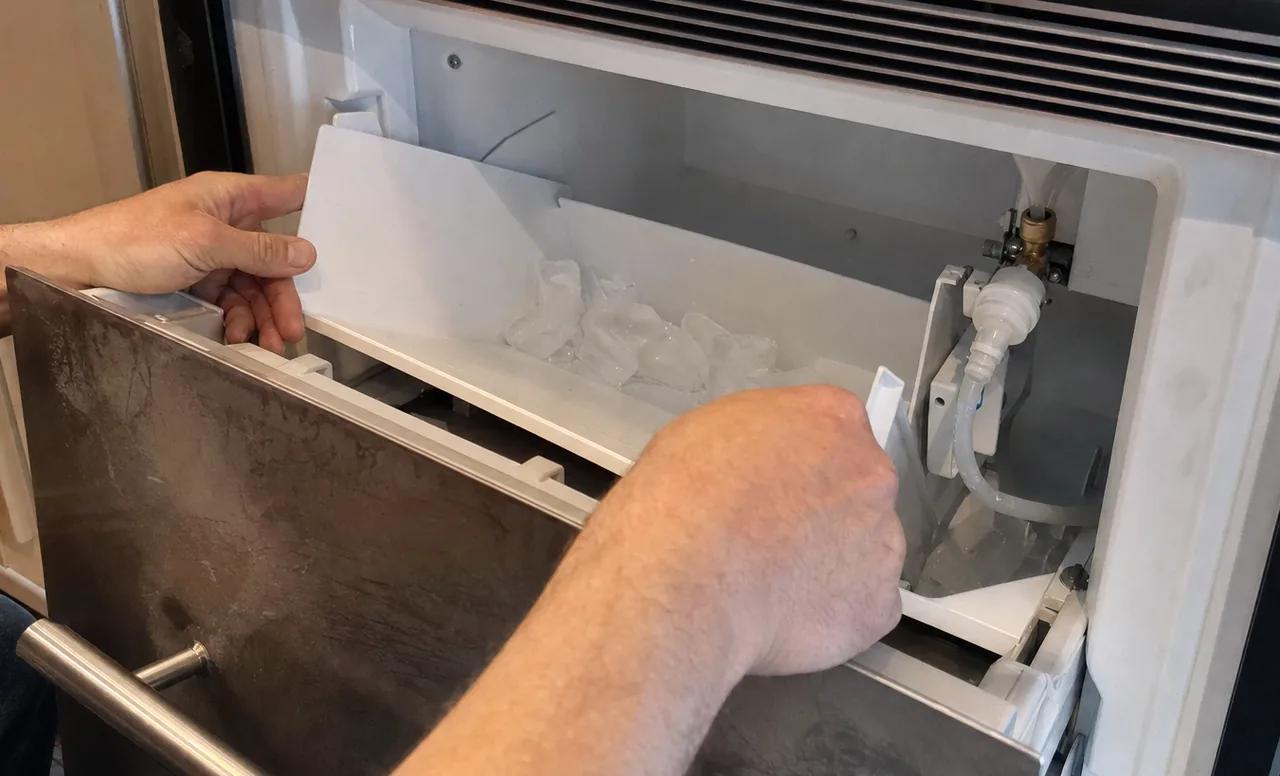
When an ice maker stops here, the first check is temperature rather than the module. Production requires the freezer at or below 5°F, with 0°F recommended. A freezer column or compartment sitting at 8°F will keep food frozen indefinitely and simply stop harvesting, and that call comes in as an ice maker fault every time.
If the compartment is at setpoint, the next question is how much water is arriving. Thin, hollow or undersized cubes are a fill problem: a saturated filter restricting flow, a supply valve never fully reopened after earlier work, a crimped line behind the cabinet, or an inlet valve not opening fully. Only one of those is a part.
A full mold that will not release is a different fault entirely — ejector, mold thermostat or mold heater — and it is separated electrically rather than by eye. Water that misses the mold and freezes a slab across the back of the compartment is a fill tube or tube heater problem. Three complaints, three repairs, and the module itself is rarely the answer.
Two systems, not one
The most common call from any ZIP, this one included, is a warm refrigerator over a freezer still holding 0°F. Every full-size cabinet in this family has two separate sealed systems — two compressors, two evaporators — with the upper circuit cool and humid and the lower circuit frigid and dry. One failing while the other runs perfectly is the normal presentation of a specific fault, and it narrows the diagnosis before anything is opened.
Repair or replace, on a cabinet this old
A large share of the work here is on cabinets outside every manufacturer warranty, and we would rather give you the honest arithmetic than a quote with the reasoning left out.
On a twenty- or thirty-year-old cabinet with sound doors, sound panels and a fitted opening, an evaporator fan, a defrost heater, a thermostat, a set of gaskets, a hinge or a frozen drain is nearly always worth repairing. The expensive part of a built-in installation is not the box, it is the cabinetry around it, and a replacement is a joinery job as well as an appliance purchase.
A failed compressor or a leaking evaporator on an uncovered cabinet is the other case. We will price it, tell you what the unit is realistically likely to give you afterward, and then leave the decision alone. For cabinets that are still inside the twelve-year limited sealed-system window, the covered part is supplied parts-only from the manufacturer with the homeowner paying labor, which changes that arithmetic completely — so the serial gets read before anything else is discussed.
Storms
Around sixty-eight thunderstorm days a year put transients on residential circuits here as everywhere in this metro, and older branch wiring offers less protection than newer. Control faults on cabinets past eight years are routine, and they usually surface weeks after the weather. Board fit is serial-dependent, so we do not publish part numbers as definitive and the plate is read on site.
Drive and booking
Orange Park is about 16 road miles from Fruit Cove, roughly 26 minutes, since the trip crosses the river on the Buckman Bridge rather than following the map straight across. It is comfortably inside our 40 road mile area.
Monday to Friday 8am to 6pm, Saturday 9am to 4pm, by appointment. No after-hours service. $80 flat diagnostic, credited toward the repair, written estimate before any part is ordered.