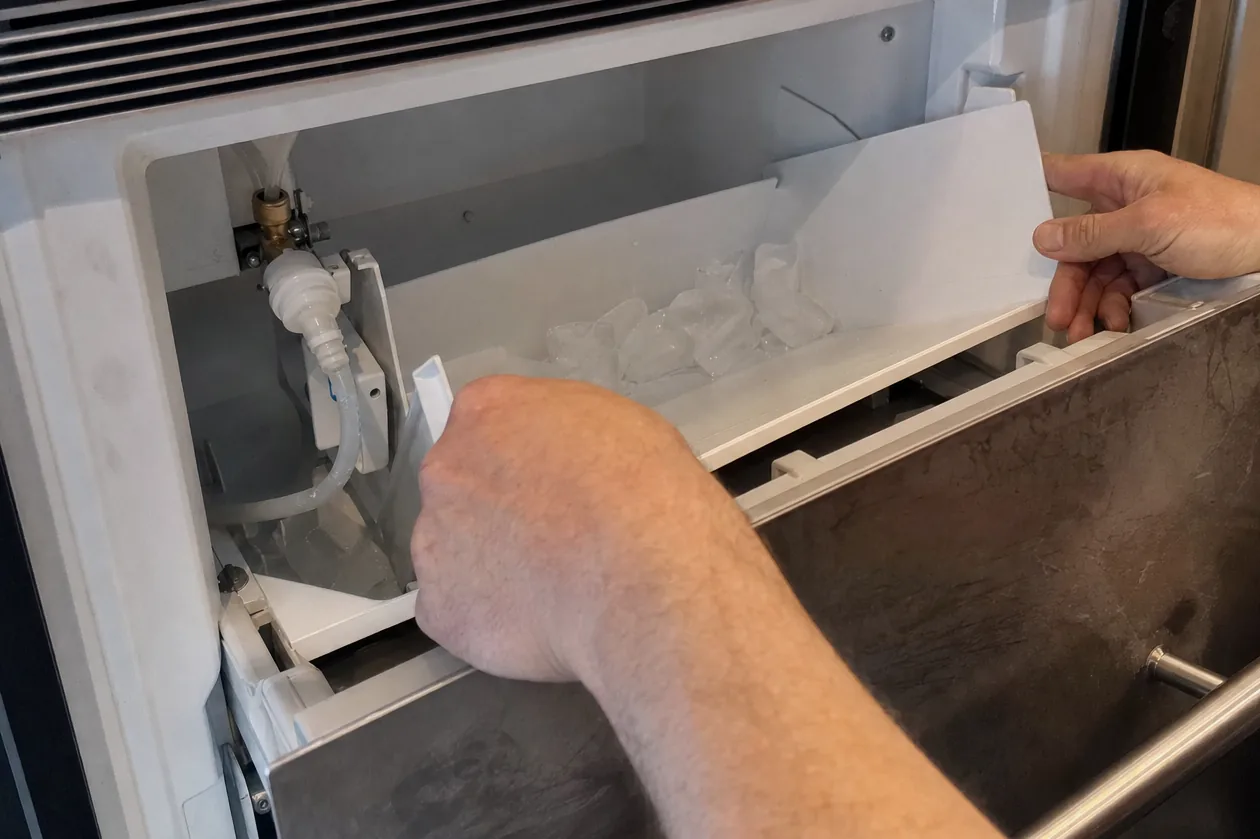
The UC cabinets are the 15 and 24 inch units that go under counters, into islands, into butler’s pantries and, in this part of Florida, into outdoor kitchens under a lanai. The common ones here are the UC-15I ice maker, the UC-24R refrigerator and the UC-24C combination cabinet.
They are simpler than a full-size built-in — one sealed system rather than two — and they fail more often, because of where they live.
One grille, doing everything
Every undercounter cabinet breathes at the base. The condenser sits behind the front grille and that single opening handles both intake and discharge. Nothing about the design is forgiving of restriction.
The list of things that restrict it is short and entirely non-technical. A decorative toe-kick added during a refresh. A new floor with a thicker underlay that lifts the cabinetry and drops the clearance. A rug pushed up against the base. Trim run across the opening by a carpenter who did not know what it was for. Each of these raises head pressure, extends run time and eventually stops the cabinet holding setpoint.
Clean the condenser every six to twelve months, every six with pets, and skip it entirely on a cabinet less than six months old.
Ambient temperature is the other half
An undercounter unit in an air-conditioned kitchen has an easy job. The same unit in an outdoor kitchen in Nocatee, Ponte Vedra Beach or Marsh Creek is working against ambient air in the nineties for four months of the year.
Indoor-rated cabinets installed outdoors show a characteristic pattern: continuous run, a drift warm through the afternoon, recovery overnight, and complete recovery in November. No component replacement changes that. We measure the air at the grille before quoting anything, and where the answer is placement rather than parts we say so.
The UC-15I gravity drain
The UC-15I is a gravity-drain machine. The drain line must fall continuously from the cabinet to the connection. A line that has been re-routed during a cabinetry job, or that sags between joists, holds water and eventually overflows at the cabinet.
Water on the floor under an undercounter ice maker is a plumbing geometry problem far more often than it is a failed part. We check the fall before we check anything else.
Filters and the ice system
The UC-15I takes water filter 7042803, which replaced 7012333. Different cabinets in the range take different cartridges, so the plate is read before a filter is ordered.
The cartridge is a maintenance item rather than a repair part, and the reason to change it on schedule is flow. A saturated filter restricts the supply, and reduced supply on a machine with this duty cycle shows up quickly as thin, wet or undersized ice.
An undercounter ice maker runs a small mold hard, so it reports a problem earlier than the main cabinet does. Wet or clumped ice on a cabinet that is otherwise cold is nearly always an ice-system fault rather than a refrigeration one, and it divides three ways: a short fill upstream of the mold, a harvest fault at the ejector or mold thermostat, or a diverted fill tube. They are separated by measuring the fill and reading the harvest cycle, not by replacing the module and hoping.
Salt air
Outdoor and near-coastal cabinets in 32082, 32250, 32266, 32233 and along the St. Augustine waterfront take a second kind of damage. Salt aerosol enters through the front grille with the cooling air and attacks aluminium fin stock, fasteners and hinge hardware.
On a ten-year-old outdoor UC, corroded fins and a seized hinge are often the whole repair, and both are visible in the first ten minutes.
Doors, drawers and the seal
Undercounter doors and drawers carry custom panels and heavy handles on short runners. Alignment drifts. Most cabinets that will not seat need adjustment, not parts.
There is no lock. The seal grips for a few seconds after closing because the trapped air has cooled and contracted, and it releases as pressure equalises. Forcing a door in that window is how gaskets get torn.
Cost
$80 flat diagnostic, credited toward the repair. Written estimate first. Genuine OEM parts, 90 days on labor, 365 days on parts.